
In a technology that can bring down costs significantly of launching satellites, India will test a reusable launch vehicle in September.

India will test a reusable launch vehicle next month, a technology that will bring down costs of launching satellites significantly, government said on Monday.

India is set to take its first steps towards its own human space flight when the uncrewed Gaganyaan mission soars to the skies later this year. Private players in the space sector are also gearing up for launching satellites on home-built rockets.

A Spanish startup, Orbital Paradigm, claims its payload, KID, survived the failed PSLV-C62 mission and transmitted data, despite ISRO's silence on the matter. The mission, carrying 16 satellites, failed due to issues in the rocket's third stage.

Top space scientist G Madhavan Nair said it may take ten years for the country to put in place such an operational rocket.
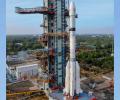
At 6.23 am on 29.1.2025, the 50.9 metre tall and weighing 420.7 ton Geosynchronous Satellite Launch Vehicle-F15 (GSLV-F15) is slated to blast off from the second launch pad carrying the 2,250 kg NVS-02 navigation satellite.

This is the second of the series conducted at Aeronautical Test Range, Chitradurga, in Karnataka at 7.10 am.

The third and final test in the series of landing experiment (LEX-03) was conducted at 07:10 1ST at the Aeronautical Test Range in Chitradurga, Karnataka.
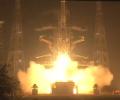
The Indian Space Research Organisation successfully launched its 100th mission on Wednesday, with a GSLV rocket carrying navigation satellite NVS-02.

The Elon Musk-headed SpaceX's newest Starship exploded ahead of a routine engine test in Texas, leading to a complete loss of the aircraft and damage to the immediate area surrounding the stand, the company has said.

A man has built an eco-friendly house with mud, mud tiles, jute, metal, and toys in Kozhikode, Kerala.
India on Monday successfully launched the first technology demonstrator of indigenously made Reusable Launch Vehicle, capable of launching satellites into orbit around earth and then re-enter the atmosphere, from Sriharikota in Andhra Pradesh.

ISRO launched 12 Indian, 22 foreign satellites and successfully flight-tested India's first winged-body aerospace vehicle.

After the historic success of its Chandrayaan-3 lunar mission, Indian Space Research Organisation (ISRO) is going full throttle with its plans to send Indian astronauts for the first time to the Moon by 2040, ISRO Chairman S Somanath said.

Around 600 scientists and engineers are hoping for the best as they forge ahead with plans of making an indigenous version of a space shuttle.

The RISAT-2B would replace the RISAT-2, which has been actively used by India to monitor activities in camps across the border in Pakistan to thwart infiltration bids by terrorists.

Noting that the PSLV was a versatile launch vehicle which can do different jobs and put satellites in different orbits, he said streamlining of this operation with improved capabilities is on.
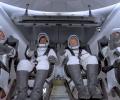
The Lucknow-born Shukla, former NASA astronaut Mission Commander Peggy Whitson, Slawosz Uznanski-Wisniewski of Poland, and Tibor Kapu of Hungary are part of the Axiom-4 mission that marks the return to space for the three nations.

India is all set for the maiden launch on Monday of an indigenous winged Reusable Launch Vehicle--that is being dubbed as its own space shuttle--from Sriharikota spaceport in Andhra Pradesh.

Engineers from Space X said that the 400-foot-tall ship, launched from the company's Starbase facility near Boca Chica Beach in Texas, lost altitude control after several engines stopped working 20 seconds before the end of the ascent burn.

In his address, the air chief marshal underlined that with a massive surge of new technologies and opening up of space to private players, there is a "disruption in the established scheme of things".

'What we are trying for is to make space travel easier like air travel.' 'We have already established ourselves... the fact that other countries are coming to seek our help shows our technology is mature.'

The first 'Pad Abort Test' demonstrated the safe recovery of the crew module in case of any exigency at the launch pad, the Indian Space Research Organisation said in a release.
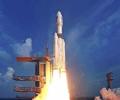
If successful, this would increase capacity to hurl small satellites into space, meeting both local demand and serving global customers.

India will join an elite group of nations with the launch of a new mission to test re-entry technology, which would be a forerunner to developing reusable vehicles like space shuttles.

'We are looking at a joint venture between ISRO and a few companies to assemble the PSLV and launch it from Sriharikota.' 'In a month or two, the vehicle assembly building will be ready.' 'After that, we could see 13, 14 launches a year.'

'We have all the technologies available, but it should be converted to something that can be commercially viable.'

Meet Chhotu Sharma -- the perfect example of what happens when determination meets hard work.
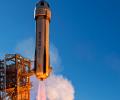
Blue Origin's 10th human flight, NS-30, will lift off from Launch Site in West Texas on Tuesday, February 25.

K Sivan has to hasten the effort to bring in private players into satellite and rocket building and replicate India's software success in aerospace.

Thotakura was selected as one of the six crew members for the mission, making him the first Indian space tourist and the second Indian to venture into space after the Indian Army's Wing Commander Rakesh Sharma in 1984.

Thotakura was selected as one of the six crew members for the NS-25 mission, making him the first Indian space tourist and the second Indian to venture into space after the Indian Army's Wing Commander Rakesh Sharma in 1984.

India is the fourth country to demonstrate the flight testing of Scramjet Engine after the United States, Russia and European Space Agency.

In a shot in the arm for Space Exploration Technologies, or SpaceX, founded by high-tech entrepreneur Elon Musk, the California-based company scripted history when its Falcon-9 rocket booster successfully landed at Cape Canaveral after despatching 11 communications satellites to orbit.

'With India's growing capabilities in the space sector, this creates promising opportunities for enhanced collaboration and market access.'

India's e-commerce market alone is projected to reach $200 billion by 2026, making it a prime industry for ambitious entrepreneurs, explains rediffGURU Harsh Bharwani.
The T-52 hour countdown for the launch of the PSLV-C7 began at 0548 hours on Monday, and it was progessing smoothly.

There is a huge spurt in demand to launch smaller satellites, those as light as 1 kg, with a lifespan of two to three years. But there aren't enough rockets to carry these, reports T E Narasimhan
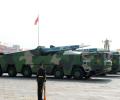
China might one day be able to launch a surprise nuclear attack on the United States, the second highest-ranking American military officer has warned as he shed new details of Beijing's hypersonic weapons test in July, which sent a missile around the world at more than five times the speed of sound.

All progress in space should excite us and encourage us to be optimists about a better future for our planet and all of us, asserts Aakar Patel.
 © 2026 Rediff.com - Advertise with us - Disclaimer - Privacy Policy - Sitemap - Feedback - About us - Terms of use - Grievances